
How can landscape architects measure the cooling effect of trees and improve outdoor thermal comfort? Discover how RhinoLands and Grasshopper turn landscape models into powerful tools for environmental analysis.
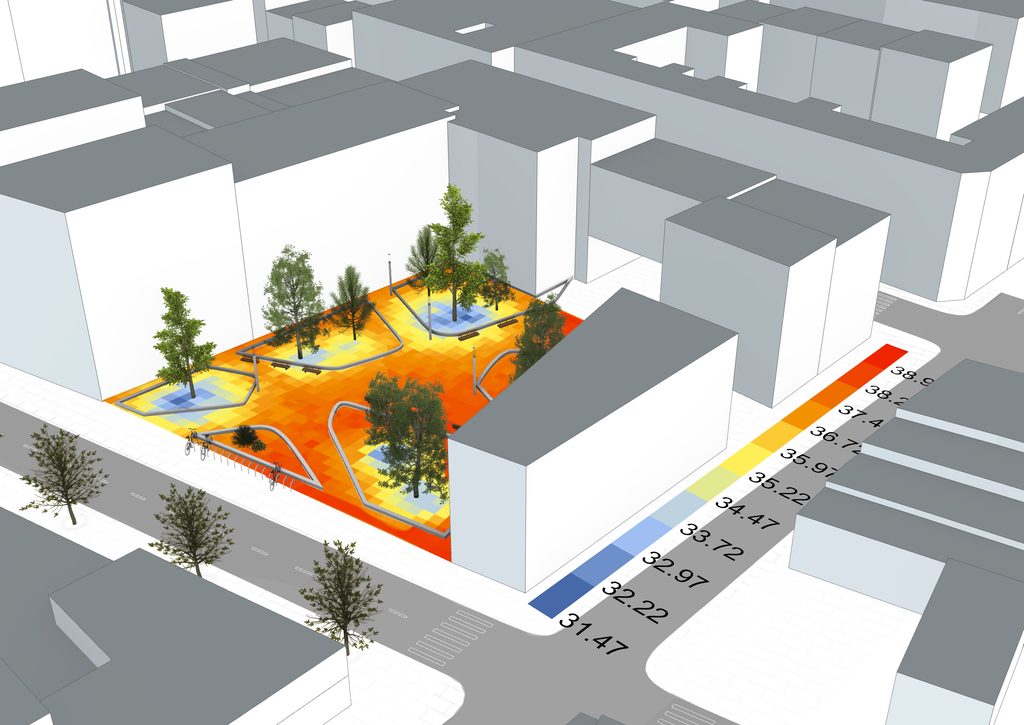
How Trees Help Reduce Urban Heat Islands
During summer, urban environments can become extremely hot. Pavements, buildings, and other hard surfaces absorb solar radiation throughout the day and release heat slowly, contributing to the urban heat island effect and making outdoor spaces uncomfortable.
Trees play an essential role in mitigating urban heat by providing shade, reducing solar exposure, and helping regulate local temperatures. But how can landscape architects measure these benefits and use them to make better design decisions?
With RhinoLands, landscape designers can create detailed 3D vegetation models and connect them to Grasshopper and Ladybug Tools to perform environmental analysis, evaluate tree shading, and study the cooling effect of vegetation throughout the year.
This approach helps transform a landscape model into a tool for designing more sustainable, climate-responsive outdoor spaces.
Measuring the Cooling Effect of Trees with a 3D Landscape Model
The accuracy of environmental analysis depends on the quality of the landscape model. Tree canopy geometry, height, density, species, age, and seasonal changes all influence how much solar radiation reaches the ground.
RhinoLands includes a botanical database of more than 8,000 plant species, allowing landscape architects to generate realistic 3D vegetation models with species-specific characteristics and growth parameters.
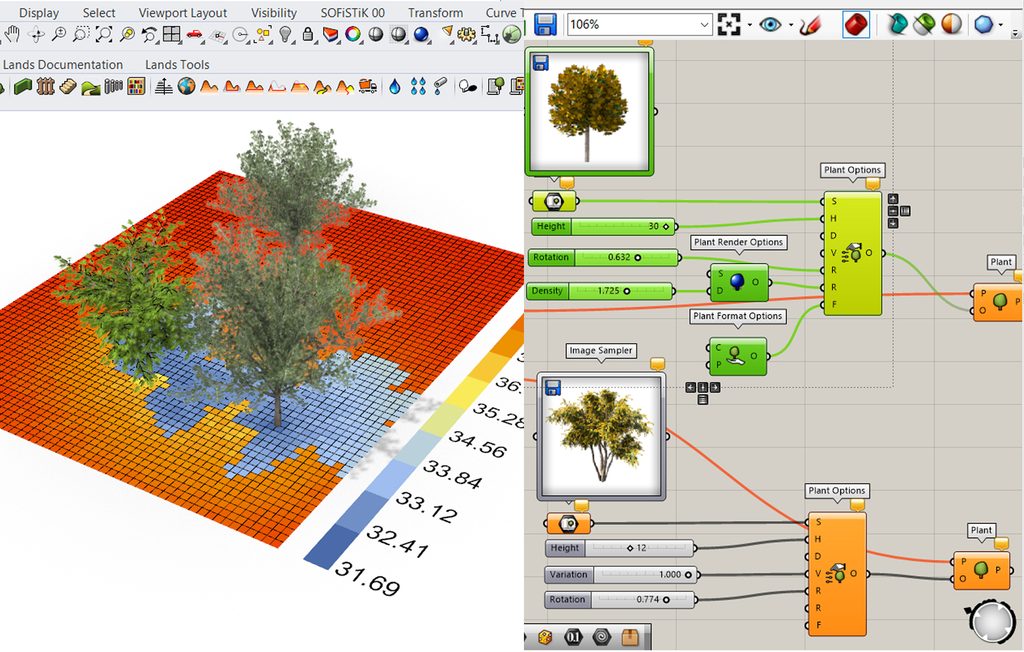
By integrating these models with Grasshopper and Ladybug Tools, designers can evaluate how tree canopies affect solar exposure and surface temperatures in different areas of a landscape project.
The results can be visualized directly on the 3D model using color gradients, making it easier to identify hotter areas, compare planting strategies, and optimize tree placement.
Surface temperature analysis using RhinoLands vegetation models and Grasshopper.
Watch the tutorial: How to Calculate the Cooling Effect of Trees in the City
Case Study: A 7°C Surface Temperature Reduction Through Tree Shading
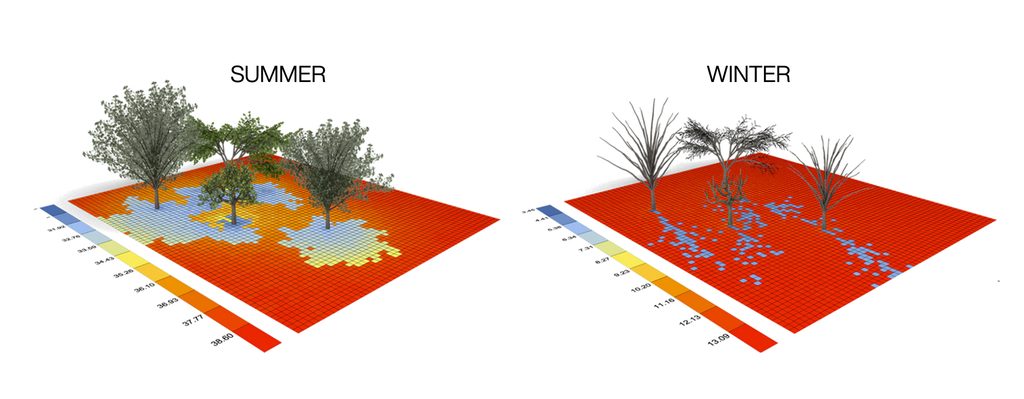
An environmental analysis carried out on a group of trees in Madrid demonstrates the measurable impact of vegetation on urban surface temperatures.
On July 15, the modeled surface temperature beneath the tree canopy decreased from 38.8°C to 31.7°C, representing a 7.1°C reduction compared with the unshaded area.
The same analysis also considered winter conditions. On January 15, when the deciduous trees had lost their leaves, the shaded area was reduced by approximately 80%, allowing more solar radiation to reach the ground. The modeled surface temperature beneath the leafless canopy was 13.09°C.
These results demonstrate how seasonal changes in vegetation can influence the thermal performance of outdoor spaces.
For landscape architects, understanding these variations is particularly valuable when designing public squares, pedestrian areas, parks, and other urban green spaces where summer shade and winter sunlight are both important.
Integrating Environmental Analysis into the Landscape Design Process
Environmental analysis becomes more useful when it is integrated directly into the design workflow.
With RhinoLands and Grasshopper, landscape architects can study the environmental performance of their designs without rebuilding the landscape model in separate software.
This allows them to:
- Optimize tree placement to provide shade where it is most needed.
- Compare planting alternatives and their effects on surface temperatures.
- Evaluate seasonal shading based on vegetation growth and deciduous foliage.
- Improve outdoor thermal comfort through informed landscape design decisions.
- Communicate environmental performance to clients, municipalities, and project stakeholders using visual analysis.
The project A Landscape Node: Green Infrastructure in Madrid, by Alberto Ferrero de la Vega, illustrates how RhinoLands and Grasshopper can support the integration of vegetation design and environmental analysis in real landscape architecture projects.
Solar Radiation Analysis for Better Plant Selection
Beyond studying the cooling effect of trees, RhinoLands can also support solar radiation analysis to understand how much sunlight individual plants receive.
Using RhinoLands vegetation objects with Grasshopper and Ladybug Tools, landscape designers can calculate solar radiation exposure and visualize the results on the 3D landscape model.
This information is particularly useful for selecting appropriate plant species, identifying areas with insufficient sunlight, and understanding how existing trees influence the growing conditions of nearby vegetation.
For example, a solar radiation study can help determine whether understory plants receive enough sunlight or whether a planting arrangement should be adjusted to improve growing conditions.
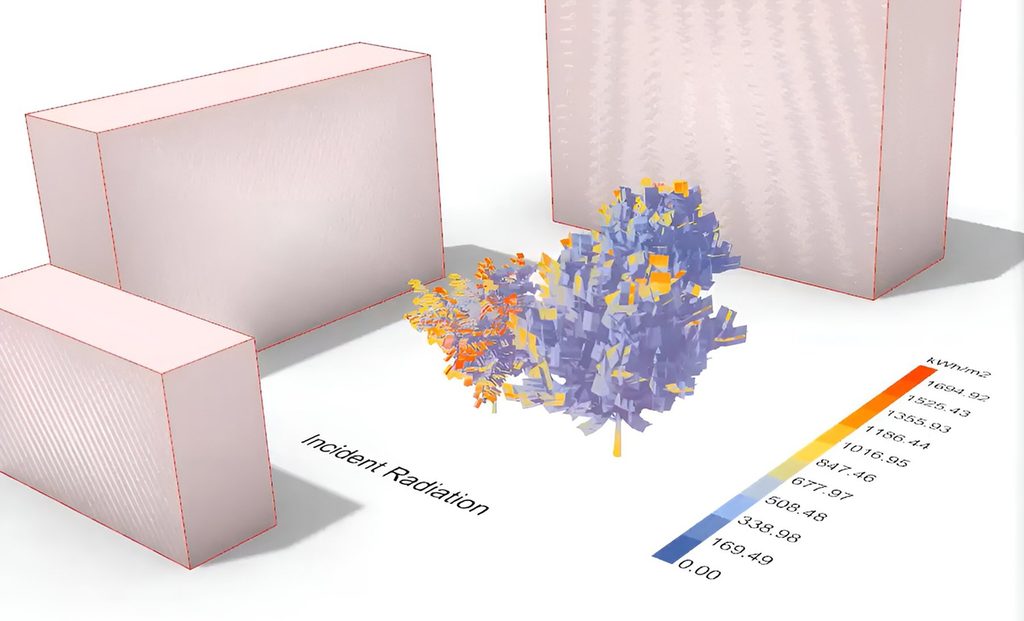
Watch the tutorial: How to Calculate the Solar Radiation Received by Plants
Designing More Sustainable Landscapes with RhinoLands
As cities face increasing temperatures, environmental analysis is becoming an important part of landscape architecture and urban design.
By combining 3D landscape modeling, vegetation design, and environmental simulation, RhinoLands helps professionals move beyond the visual representation of landscapes and evaluate how their designs perform under real climatic conditions.
From measuring the cooling effect of trees to analyzing solar radiation and seasonal shading, these workflows provide valuable information for creating more comfortable, resilient, and sustainable outdoor environments.
RhinoLands combines Rhino 8 and Lands Design in a standalone solution for landscape architecture, with integrated Grasshopper capabilities for parametric modeling and environmental analysis.
Download RhinoLands and start your free 60-day trial
The Grasshopper definitions for tree cooling effect and solar radiation analysis are also available for free on Food4Rhino.
